
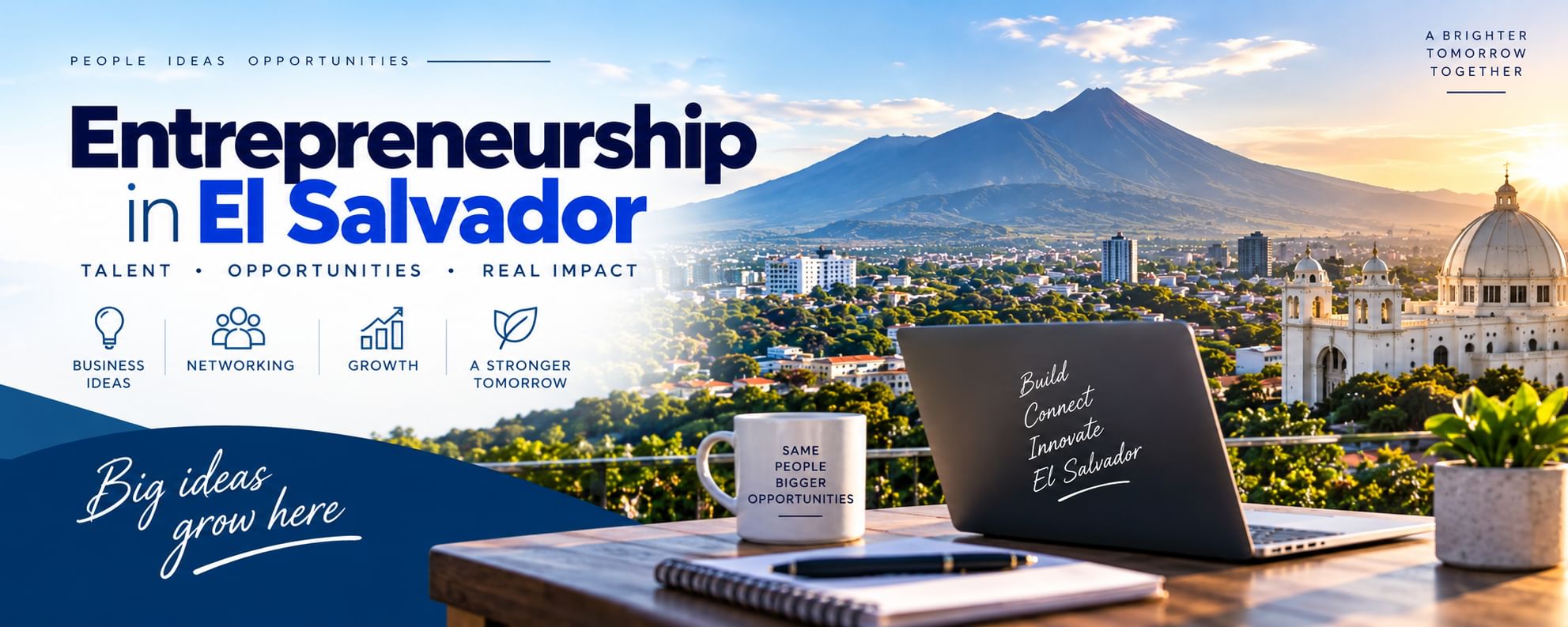
Entrepreneurship in El Salvador
El Salvador is entering a new chapter of entrepreneurship.
A country once overlooked by many international founders is increasingly attracting attention from entrepreneurs, investors, technology companies, exporters, developers, tourism operators, manufacturers, and Salvadorans returning from abroad with new ideas.
Small in size but strategically positioned in Central America, El Salvador offers something increasingly valuable to entrepreneurs: the opportunity to enter a developing market where transformation is still taking place.
For founders, that means possibilities.
For investors, it means emerging sectors.
And for Salvadorans, it means an opportunity to build businesses capable of serving both the local economy and customers far beyond the country's borders.
Why Entrepreneurs Are Looking at El Salvador
Entrepreneurship in El Salvador is being shaped by several forces at the same time.
The country's business environment is evolving. Tourism has expanded. Digital businesses have become more visible. Infrastructure investment has increased. International companies are exploring new opportunities, while local entrepreneurs continue creating businesses in commerce, food, technology, professional services, construction, tourism and other sectors.
The country's official investment strategy currently highlights industries including software, tourism, manufacturing, food and beverages, auto parts, electrical components, logistics, energy, real estate, pharmaceuticals and medical devices.
But entrepreneurship in El Salvador is not limited to large investment projects.
Some of the country's most interesting opportunities start small: a restaurant, software agency, surf business, online store, coffee brand, logistics service, marketing company, property business or specialized professional service.
That is what makes the entrepreneurial landscape interesting.
There is room for both ambitious international investment and businesses started with a laptop, a good idea and a clear understanding of the market.
A Strategic Location in Central America
Location is one of El Salvador's natural advantages.
The country sits on the Pacific coast of Central America and provides access to regional markets including Guatemala, Honduras, Nicaragua and the wider Central American economy.
For businesses involved in trade, manufacturing, distribution or logistics, that position can be particularly valuable.
El Salvador is also geographically compact.
Distances between the country's principal commercial areas, airport, ports, industrial zones, tourism destinations and San Salvador are relatively manageable compared with much larger markets.
For an entrepreneur, a smaller geography can make it easier to understand customers, build relationships, test concepts and operate nationally.
San Salvador: The Country's Business Center
San Salvador and its metropolitan area remain the center of much of the country's commercial activity.
Banks, corporate offices, technology companies, professional services, retailers, restaurants, universities and government institutions are concentrated in and around the capital.
For many entrepreneurs entering El Salvador, the metropolitan area is the natural starting point.
Areas including San Salvador, Antiguo Cuscatlán, Santa Tecla and surrounding communities support an increasingly diverse business environment.
Entrepreneurs can find traditional corporate clients alongside younger companies, freelancers, digital professionals and internationally connected businesses.
Beyond San Salvador
Entrepreneurship is not confined to the capital.
Different parts of El Salvador offer very different business opportunities.
Coastal communities can support tourism, hospitality, restaurants, surfing, accommodation and experience-based businesses.
Agricultural regions provide opportunities connected with coffee, food production, processing and exports.
Growing cities create demand for retail, healthcare, education, real estate, construction and professional services.
Historic areas can generate opportunities around hospitality, gastronomy, culture and urban tourism.
Successful entrepreneurs look beyond the question of "What business should I start?"
A better question is:
Where is demand growing, and what problem can my business solve?
The Salvadoran Startup Ecosystem
El Salvador's startup ecosystem is still developing, and that can be an advantage for certain founders.
Mature startup centers often provide more investors, accelerators and specialist talent, but they also come with intense competition and significantly higher operating costs.
Emerging ecosystems work differently.
Entrepreneurs frequently have to build their own networks, identify partners and educate customers. At the same time, strong companies can establish recognizable positions before markets become crowded.
Opportunities exist in areas such as:
- Fintech
- Software development
- E-commerce
- Digital marketing
- Artificial intelligence services
- Business automation
- Logistics technology
- Tourism technology
- Education technology
- Professional services
- Digital payments
- Cybersecurity
- Outsourcing
- Online marketplaces
Not every successful Salvadoran startup needs to target Salvadoran customers alone.
One of the biggest opportunities is building a company in El Salvador while selling services throughout Latin America, the United States or internationally.
Technology and Digital Entrepreneurship
Digital entrepreneurship removes one of the traditional limitations of operating from a smaller country.
A software developer in El Salvador can work for a company in Miami.
A marketing agency can serve clients in California.
A graphic designer can sell services throughout Europe.
A SaaS company can acquire customers anywhere in the world.
A Salvadoran e-commerce company can build an international brand without opening stores abroad.
This creates an important distinction between the location of the business and the location of its customers.
For digitally oriented founders, El Salvador can function as an operating base while revenue comes from international markets.
Software Development and IT Services
Software is one of the sectors specifically promoted by El Salvador's investment agency.
Potential business models include:
- Custom software development
- Mobile application development
- Web development
- Cloud services
- AI implementation
- Business process automation
- Data analytics
- Cybersecurity
- Technical support
- Nearshore development teams
- Software-as-a-Service products
Demand does not necessarily need to originate inside El Salvador.
Nearshoring creates opportunities for businesses capable of serving North American companies from compatible time zones while providing bilingual or internationally oriented teams.
Tourism Entrepreneurship
Tourism has become one of the most visible areas of economic opportunity in El Salvador.
The country's Pacific coastline, surf destinations, volcanoes, lakes, historic centers, food culture and compact geography give entrepreneurs multiple ways to build tourism-related businesses.
Official investment materials report more than four million international visitors during 2025 and continued growth in the tourism sector.
Entrepreneurial opportunities include:
- Boutique hotels
- Vacation rentals
- Surf schools
- Restaurants and cafés
- Transportation
- Guided tours
- Outdoor activities
- Event businesses
- Travel technology
- Wellness tourism
- Cultural experiences
- Tourist retail
- Destination marketing
The strongest tourism businesses often do more than sell accommodation or transportation.
They sell an experience.
Surf and Coastal Business Opportunities
El Salvador's Pacific coast has become internationally associated with surfing.
That creates an ecosystem extending far beyond surf schools.
Accommodation, restaurants, cafés, transport, property management, equipment rental, photography, events, wellness services, coworking and digital-nomad services can all develop around tourism destinations.
Entrepreneurs who understand both local communities and international visitors can be particularly well positioned.
Food, Coffee and Agriculture
El Salvador has a strong agricultural and culinary identity.
Coffee remains one of the country's internationally recognizable products, but entrepreneurship can extend far beyond traditional agricultural exports.
Businesses can create value through:
- Specialty coffee brands
- Coffee roasting
- Direct-to-consumer sales
- Food processing
- Premium agricultural products
- Packaging
- Distribution
- Export services
- Restaurants
- Artisan food products
- Online food brands
Consumers increasingly care about origin, quality and story.
That gives Salvadoran producers the opportunity to sell not simply a product, but a product connected with a place.
Manufacturing and Export Businesses
El Salvador also has an established manufacturing base.
Government investment materials currently highlight manufacturing, textiles and apparel, auto parts, electrical components, food and beverage production and other export-oriented industries.
For entrepreneurs, opportunity can exist both inside factories and around them.
Manufacturing ecosystems require:
- Suppliers
- Transportation
- Packaging
- Industrial maintenance
- Software
- Recruitment
- Quality control
- Warehousing
- Import and export services
- Security
- Accounting
- Engineering
- Business-to-business services
Entrepreneurship does not always mean inventing an entirely new industry.
Sometimes the strongest business is the company supplying an existing one.
Logistics and Distribution
Every growing economy needs products moved efficiently.
El Salvador's geographic size and connection with regional markets create opportunities in logistics, distribution, warehousing and transportation.
Businesses can specialize in areas such as last-mile delivery, cross-border logistics, inventory management, freight coordination and technology that helps companies manage supply chains more effectively.
As e-commerce expands, logistics becomes even more important.
A website can take an order in seconds.
Delivering the product efficiently is the harder part.
Real Estate and Construction
Economic development, tourism and urban investment create opportunities throughout the property industry.
These can include:
- Residential development
- Commercial property
- Tourism accommodation
- Property management
- Vacation rentals
- Construction services
- Architecture
- Interior design
- Building technology
- Property marketing
- Maintenance
- Real estate technology
Entrepreneurs do not necessarily need to become property developers themselves.
Every new residential, tourism or commercial development creates demand for dozens of supporting services.
Professional Services
One of the easiest entrepreneurial sectors to underestimate is professional services.
Every growing company eventually needs specialists.
Accountants, lawyers, recruiters, consultants, designers, marketing agencies, developers, photographers, translators and financial professionals can build businesses around the growth of other businesses.
Specialization can create an advantage.
Instead of being simply a "marketing agency," a company might specialize in marketing Salvadoran tourism businesses to American customers.
Instead of being a general software developer, a company could specialize in software for logistics companies.
Specific expertise is often easier to sell than general capability.
E-Commerce
E-commerce gives Salvadoran entrepreneurs access to customers without requiring expensive physical retail locations.
Potential models include local online stores, niche marketplaces, imported products, Salvadoran-made goods, subscription products and internationally marketed brands.
Entrepreneurs can combine social media, marketplaces, websites and delivery services to build businesses with relatively lean infrastructure.
The key challenge is not simply creating an online store.
Successful e-commerce requires reliable logistics, good customer service, compelling products and profitable customer acquisition.
The Creator Economy
Entrepreneurship no longer requires a traditional office or storefront.
Content creators, influencers, educators, photographers, video producers, podcasters and niche media publishers can build businesses around audiences.
El Salvador provides particularly strong visual material for travel, food, surfing, culture, business and lifestyle content.
A creator can eventually monetize through advertising, sponsorships, affiliate marketing, courses, consulting, events or their own products.
In today's economy, attention itself can become a business asset.
Salvadorans Abroad and the Diaspora Opportunity
El Salvador has a large international diaspora, particularly in the United States.
That creates unique entrepreneurial connections between Salvadorans living abroad and businesses operating inside the country.
Diaspora entrepreneurs can bring:
- Capital
- International business experience
- Professional networks
- Foreign customers
- Technology
- Market knowledge
- Distribution relationships
At the same time, locally based companies can create products and services designed specifically for Salvadorans living overseas.
Businesses connecting El Salvador with its diaspora can potentially operate across two markets rather than one.
Starting a Company in El Salvador
Entrepreneurs considering establishing a formal business should understand the legal and administrative requirements before beginning operations.
El Salvador's official investment agency publishes a dedicated 2026 company setup guide covering the process for establishing a company.
The exact structure will depend on the business, its owners, employees, activities and tax situation.
Entrepreneurs should obtain qualified local legal and accounting advice when establishing a company.
Important areas generally include:
- Choosing the appropriate legal structure
- Registering the company
- Tax registration
- Accounting obligations
- Municipal requirements
- Employment registration
- Business licenses
- Industry-specific permits
- Banking
- Contracts
- Intellectual property
- Compliance requirements
Starting correctly can prevent expensive problems later.
Foreign Entrepreneurs
El Salvador actively promotes investment by both Salvadoran and foreign businesses, with INVEST El Salvador providing institutional assistance for companies evaluating or developing projects in the country.
Foreign entrepreneurs should nevertheless treat market entry as more than a legal registration exercise.
Understanding local business culture matters.
Relationships matter.
Reliable local partners matter.
Knowledge of customers matters.
An entrepreneur who understands the market will generally have an advantage over someone who simply sees attractive numbers from abroad.
Investment Incentives
Different incentives and special regimes may be available depending on the industry, location and type of investment.
El Salvador's official investment agency currently lists incentives and special regimes associated with strategic sectors and export-oriented activities.
These incentives should never be treated as universal.
Entrepreneurs should verify eligibility and obtain current professional advice before making investment decisions based on tax or regulatory benefits.
A good business should make economic sense before incentives.
Incentives should improve a strong project rather than rescue a weak one.
Financing a Business
Finding capital is one of the biggest challenges for entrepreneurs everywhere.
Possible financing sources in El Salvador can include:
- Personal savings
- Family capital
- Business partners
- Commercial loans
- Angel investors
- International investors
- Development programs
- Private investment funds
- Supplier financing
- Customer-funded growth
- Foreign capital
Not every company needs venture capital.
In fact, many successful businesses are built through revenue.
A profitable business that grows steadily may ultimately create more value than a startup that raises large amounts of outside capital but never develops sustainable economics.
Bootstrapping
Bootstrapping can be particularly relevant in emerging entrepreneurial ecosystems.
The strategy is simple:
- Start small.
- Control costs.
- Find customers.
- Generate revenue.
- Reinvest profits.
- Expand gradually.
This approach forces businesses to focus on something that sometimes disappears from startup culture:
Customers willing to pay.
Bitcoin and Digital Assets
El Salvador became internationally famous for its Bitcoin experiment, but entrepreneurs should understand the current legal situation rather than relying on outdated headlines.
Following reforms approved in 2025, private-sector acceptance of Bitcoin became voluntary rather than mandatory, and tax obligations are paid in U.S. dollars. The U.S. dollar remains central to normal business accounting and transactions.
At the same time, digital assets remain an area of interest in the country's investment strategy.
For entrepreneurs, this can create opportunities in fintech and digital financial infrastructure, but crypto-related ventures require particularly careful attention to regulation, compliance, consumer protection and risk.
Talent
Businesses ultimately depend on people.
El Salvador has universities, technical professionals, bilingual workers and a growing population of young people participating in digital industries.
For employers, the opportunity is not simply finding employees.
It is developing talent.
Companies that invest in training can build teams around their specific needs.
This is particularly important in software, digital marketing, hospitality, advanced manufacturing, finance and business services.
English-Language Skills
English ability can be an important competitive advantage for Salvadoran companies targeting international markets.
Businesses serving customers in the United States can benefit from hiring and developing bilingual employees for sales, customer service, technology and professional services.
Entrepreneurs building internationally oriented companies should treat language training as an investment rather than an expense.
Business Culture
Doing business successfully in El Salvador requires understanding people as well as spreadsheets.
Trust and personal relationships can play an important role in commercial relationships.
Introductions, reputation and reliability matter.
Foreign entrepreneurs should take time to understand local expectations rather than assuming that business practices work exactly as they do elsewhere.
Strong relationships can become one of a company's most valuable competitive advantages.
Infrastructure and Connectivity
Infrastructure plays a central role in entrepreneurship.
Air connectivity, telecommunications, roads, electricity, ports and internet access affect everything from tourism to software development.
Companies should evaluate infrastructure based on their own operational needs rather than relying only on national averages.
A software company has very different requirements from a manufacturing facility.
A surf hotel has different priorities from a logistics warehouse.
Location should therefore be part of the business strategy.
Safety and the Changing Business Environment
One of the most significant changes affecting El Salvador's international image has been the dramatic reduction in reported homicide rates.
Official investment materials report a homicide rate of 1.3 per 100,000 inhabitants for 2025 and promote improved security as an important part of the country's investment environment.
For entrepreneurs, security can influence tourism, opening hours, commercial property, transportation, employee mobility and willingness to invest.
At the same time, businesses should always conduct their own location-specific risk assessment rather than treating national statistics as a guarantee for every area.
Challenges Entrepreneurs Should Understand
Entrepreneurship in El Salvador offers possibilities, but it is not without challenges.
Businesses may encounter difficulties involving access to finance, bureaucracy, specialist talent, informal competition, limited domestic purchasing power or changing regulatory requirements.
Smaller markets also have natural limits.
Some niche businesses may simply not have enough local customers to scale significantly.
The solution is often to think beyond the country's borders.
A company might operate in El Salvador while targeting Central America.
Or the United States.
Or the entire Spanish-speaking market.
The country can be the base without being the boundary.
Entrepreneurship and Artificial Intelligence
Artificial intelligence is creating an entirely new category of opportunity for entrepreneurs.
Businesses no longer need enormous development teams to automate processes, analyze information, create content or provide sophisticated digital services.
Salvadoran entrepreneurs can use AI in:
- Marketing
- Customer support
- Software development
- Data analysis
- Education
- Accounting
- Tourism
- E-commerce
- Translation
- Recruitment
- Business automation
The biggest opportunities may not come from building new AI models.
They may come from applying existing AI technology to ordinary industries more effectively than competitors.
Opportunities for Young Entrepreneurs
Entrepreneurship can give younger Salvadorans an alternative to traditional career paths.
A business can start with relatively simple skills:
- Web design
- Photography
- Video production
- Advertising
- Software development
- Food delivery
- Tourism services
- Online education
- E-commerce
- Consulting
The first business does not need to become a multinational company.
The experience of finding customers, negotiating prices, managing expenses and delivering a service can create skills that remain valuable for life.
Women in Entrepreneurship
Women already play a major role in small businesses, professional services, retail, food, hospitality and online commerce.
Digital tools can create additional opportunities by reducing the capital required to reach customers.
A business can increasingly begin from a phone or laptop before moving into a physical location.
Continued expansion of access to financing, training, professional networks and technology can help more female entrepreneurs build scalable businesses rather than remaining limited to subsistence activity.
Social Entrepreneurship
Not every entrepreneur measures success only in profit.
Social businesses can address problems involving education, employment, sustainability, recycling, healthcare, agriculture and community development.
A successful social enterprise combines impact with financial sustainability.
The business still needs customers, revenue and disciplined management.
The difference is that growth also creates measurable social value.
Sustainable Business Opportunities
Sustainability can itself become a business opportunity.
Potential areas include:
- Renewable energy
- Energy efficiency
- Waste management
- Recycling
- Sustainable construction
- Water technology
- Eco-tourism
- Sustainable agriculture
- Reusable packaging
- Electric mobility
Companies that reduce costs while reducing environmental impact can create particularly attractive value propositions.
Buying an Existing Business
Starting from zero is not the only route into entrepreneurship.
Entrepreneurs can also acquire an existing business.
A functioning company may already have:
- Customers
- Employees
- Suppliers
- Revenue
- Licenses
- Equipment
- Brand recognition
- Operating history
The challenge is evaluating whether those assets are truly valuable.
Buying a poor business does not automatically make entrepreneurship easier.
Detailed financial, legal and operational due diligence is essential.
Franchises
Franchising provides another route into business ownership.
The entrepreneur operates under an established brand and business system rather than creating everything independently.
Franchises can reduce certain startup risks but introduce other considerations such as franchise fees, royalties, operating restrictions and dependence on the franchisor.
Entrepreneurs should compare the cost of buying a business system with the potential benefit of building their own brand.
Networking
Entrepreneurship is rarely a solo activity.
Founders need customers, employees, accountants, lawyers, developers, suppliers, investors and advisers.
That makes networking extremely valuable.
Entrepreneurs should actively build relationships through:
- Business associations
- Industry events
- Startup communities
- Universities
- Professional organizations
- Coworking spaces
- Online communities
- International business networks
One conversation can lead to a customer.
One customer can lead to ten introductions.
Networks compound.
The Importance of Sales
Great ideas do not automatically become great businesses.
Someone needs to buy.
Sales should therefore be one of the first skills every entrepreneur develops.
A founder should be able to explain:
- What problem does the business solve?
- Who has that problem?
- Why is the solution better?
- Why should the customer trust the company?
- How much does it cost?
- Why should the customer act now?
Entrepreneurship becomes much easier once those answers are clear.
Building for El Salvador — and Beyond
Perhaps the biggest opportunity for Salvadoran entrepreneurship is the ability to combine local knowledge with international markets.
A company can employ people in El Salvador and serve customers in the United States.
A coffee producer can sell directly to consumers overseas.
A software company can build products for Latin America.
A hotel can attract visitors from Europe.
A manufacturer can become part of an international supply chain.
A creator can reach millions of people without leaving the country.
Geography matters less than it once did.
Ambition can travel.
A New Generation of Salvadoran Businesses
The next generation of successful Salvadoran companies may look very different from the businesses that came before them.
Some will be technology companies.
Some will manufacture physical products.
Some will operate hotels or restaurants.
Others will export knowledge rather than goods.
Many will combine several models at once.
A coffee company can be an agricultural business, consumer brand, e-commerce company and tourism experience.
A surf hotel can combine hospitality, events, content and retail.
A software agency can eventually create its own product.
Entrepreneurship rewards people who see connections others overlook.
Start With a Problem
The best business ideas usually begin with observation.
What takes too long?
What costs too much?
What service is unreliable?
What do tourists struggle to find?
What do companies repeatedly outsource?
What product do consumers import because they cannot find a good local alternative?
Where are people still using spreadsheets when software could solve the problem?
Where is demand growing faster than supply?
Those questions are often more valuable than trying to invent something completely new.
Start Small. Think Big.
Entrepreneurship does not require beginning with a large office, dozens of employees or millions of dollars.
It begins with creating value for someone else.
One customer becomes ten.
Ten become one hundred.
A small local service can become a national business.
A Salvadoran company can become an international company.
The important part is beginning with a real need and building something people genuinely want.
Why El Salvador?
El Salvador offers entrepreneurs an unusual combination.
A compact domestic market.
A strategic Central American location.
Growing tourism.
Emerging digital industries.
Established manufacturing.
Connections with the United States.
A large international diaspora.
Developing investment opportunities.
And a business environment that continues to evolve.
It will not be the right location for every company.
But for entrepreneurs who understand the market, build strong local relationships and think internationally, El Salvador can offer something more valuable than a mature market:
room to build.
The Future Is Built by Entrepreneurs
Economic transformation ultimately happens one business at a time.
Someone opens the restaurant. Someone writes the software. Someone develops the property. Someone exports the coffee. Someone creates the hotel. Someone builds the brand. Someone hires the first employee. Someone decides that an idea is worth trying.
That is entrepreneurship.
And in El Salvador, the next generation of businesses is still being built.
People. Ideas. Opportunities.
Entrepreneurship in El Salvador starts with what comes next.